5. Heap & Priority Queues
Heap / Priority Queue
Heaps and priority queues are similar to queues, except internally they are structured in a way to keep an ordering - max heaps has the largest item as the root node, and min heaps have the smallest item
The actual internal data structure is a binary tree where certain rotations, replacements, and updates are done on the tree when we run heap.pop() or heap.push()
The main benefit of this is that an insertion happens in time, but peeking the largest or smallest element is guaranteed . Removing the actual max / min element is still as you have to do more rotations now that the root is gone
You can think of these items as a sorted array, except arrays require shuffling when items are inserted or removed, where heaps are stored as binary trees so this shuffling isn't , but
| Type | Insert | Search (Max only) | Delete |
|---|---|---|---|
| Best Case | O(logn) | O(1) | O(logn) |
| Average Case | O(logn) | O(1) | O(logn) |
| Worst Case | O(logn) | O(1) | O(logn) |
Implementation
Requirements:
- For any node
Athat's a parent ofB, it must be thatA.val >= B- Directly implies root node is the largest node
- The tree must be complete, which means every level, except possibly the last, is completely filled
- Ensures balanced tree to guarantee
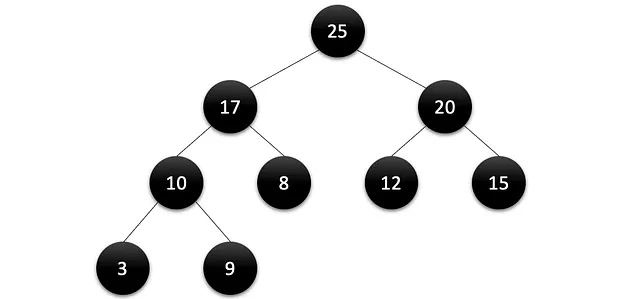
The typical implementation is done via arrays that are able to utilize index arithmetic to access nodes and parent / child relationships
iis the current node2i+1is the left child2i+2is the right child
So above max heap can be stored as arr = [25, 17, 20, 10, 8, 12, 15, 3, 9]
The fastest an arbitrary array can get turned into a heap is via sift-down or bubbling up. During inserts and deletes, rotations are needed to ensure parent.val >= child.val at all locations. The number of operations scales logarithmically with the number of elements in the heap, and so one off insertions / deletions are while heapifying an arbitrary list itself is
Swapping the last nodes, we get
arr = [9, 17, 20, 10, 8, 12, 15, 3, 25]
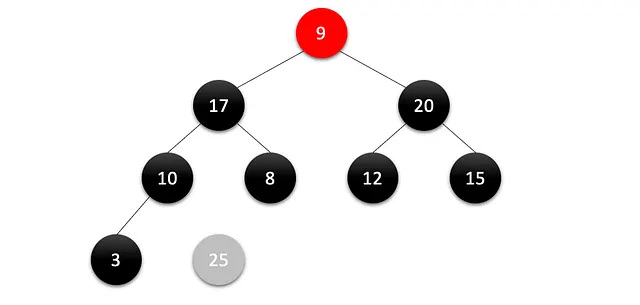
Pseudocode:
- Start at root
- Swap node with max value child
- Continue following that node down
- Stop if leaf node
def maxHeapify(A, i):
    left = 2 * i + 1
    right = 2 * i + 2
    largest = i
    if left < len(A) and A[left] > A[largest]:
        largest = left
    if right < len(A) and A[right] > A[largest]:
        largest = right
    if largest != i:
        A[i], A[largest] = A[largest], A[i]
        A = maxHeapify(A,largest)
    return A
This would need to be ran from the bottom most level of parents (i.e. the bottom most level of non-leaf nodes). This is why it's required to be a complete binary tree
def buildMaxHeap(A):
    for i in range(len(A)//2,-1,-1):
        A = maxHeapify(A,i)
    return A
maxHeapify is
buildMaxHeap is
Redis Based ZSets
Walked through [Redis ZSets for Priority Queue's](/docs/architecture_components/databases & storage/Redis/ZSETS.md)
Redis can be used as a non-local priority queue that has different memory restrictions, and is potentially more optimized than a local implementation, while giving the overall same time complexities and operations